
Visual inspection report · sample
Chimney stack & surrounding roof
| Property | Residential bungalow — address withheld in this sample |
|---|---|
| Area | Salisbury district, Wiltshire |
| Flight date | Mid-morning, autumn — full date withheld in this sample |
| Requested because | The owner wanted the chimney checked before winter without paying for scaffolding or roof access. |
| Operator | CAA-registered, flown within visual line of sight; £1,000,000 public liability cover for commercial operation |
| Deliverables | High-resolution stills of all four elevations plus overhead passes, and this written summary |
What this report is — and is not
This is a non-regulated visual inspection from the air. It records what is visible and where, in plain English, so you or your roofer can decide what to do next. It is not a structural survey, not a RICS report, and no part of the building was touched or opened up. Where we recommend work, that is a prompt to get a quote from a suitable tradesperson — not a specification.
Summary
The stack is upright and serviceable, but the top of it is where the weather has done its work: the flaunching is cracked, the top courses of brickwork have open joints with vegetation rooted in them, and the pot is open to the sky. None of this is an emergency, and nothing visible suggests water is getting into the house today — but the crown will keep deteriorating each winter it is left, and the cost of the repair grows with it. The lead flashing and the surrounding tiles are in fair order for their age.
Findings
| Element | What is visible | Condition | |
|---|---|---|---|
| 1 | Flaunching (mortar cap around the pot) Fig. 1 |
The cement flaunching is weathered and cracked, with the surface breaking down around the pot and at the edges. Heavy lichen cover. Cracked flaunching lets water into the top of the stack and can eventually let the pot work loose. | |
| 2 | Chimney pot Fig. 1 |
Single clay pot, open and uncapped — no cowl, cap or bird guard fitted. Rain and birds can enter the flue directly. The pot itself sits upright and appears sound from the air. | |
| 3 | Crown brickwork (top courses) Fig. 2 & 3 |
The top few courses show open, washed-out mortar joints and uneven brick edges, with vegetation rooted in the joints on the crown. This is the most exposed part of the stack and the most weathered. | |
| 4 | Stack brick faces Fig. 2 & 3 |
General weathering and lichen growth on the faces below the crown, with surface erosion to individual bricks — clearest on the rear face, where one brick has lost its face entirely (Fig. 3). The main body of the stack reads as sound and true; the deterioration is concentrated at the top. | |
| 5 | Lead flashing at the base Fig. 2 & 3 |
The lead apron and side flashings are aged and oxidised, with the dressing slightly uneven at the corners, but the lead is continuous all round and no staining or ingress marks are visible on the surrounding tiles. | |
| 6 | Roof covering around the stack Fig. 1 |
Concrete interlocking tiles with widespread moss and lichen, heaviest along the ridge line. No slipped, cracked or missing tiles are visible in the inspected area. Moss will keep shedding into the gutters, which is a maintenance point rather than a defect. |
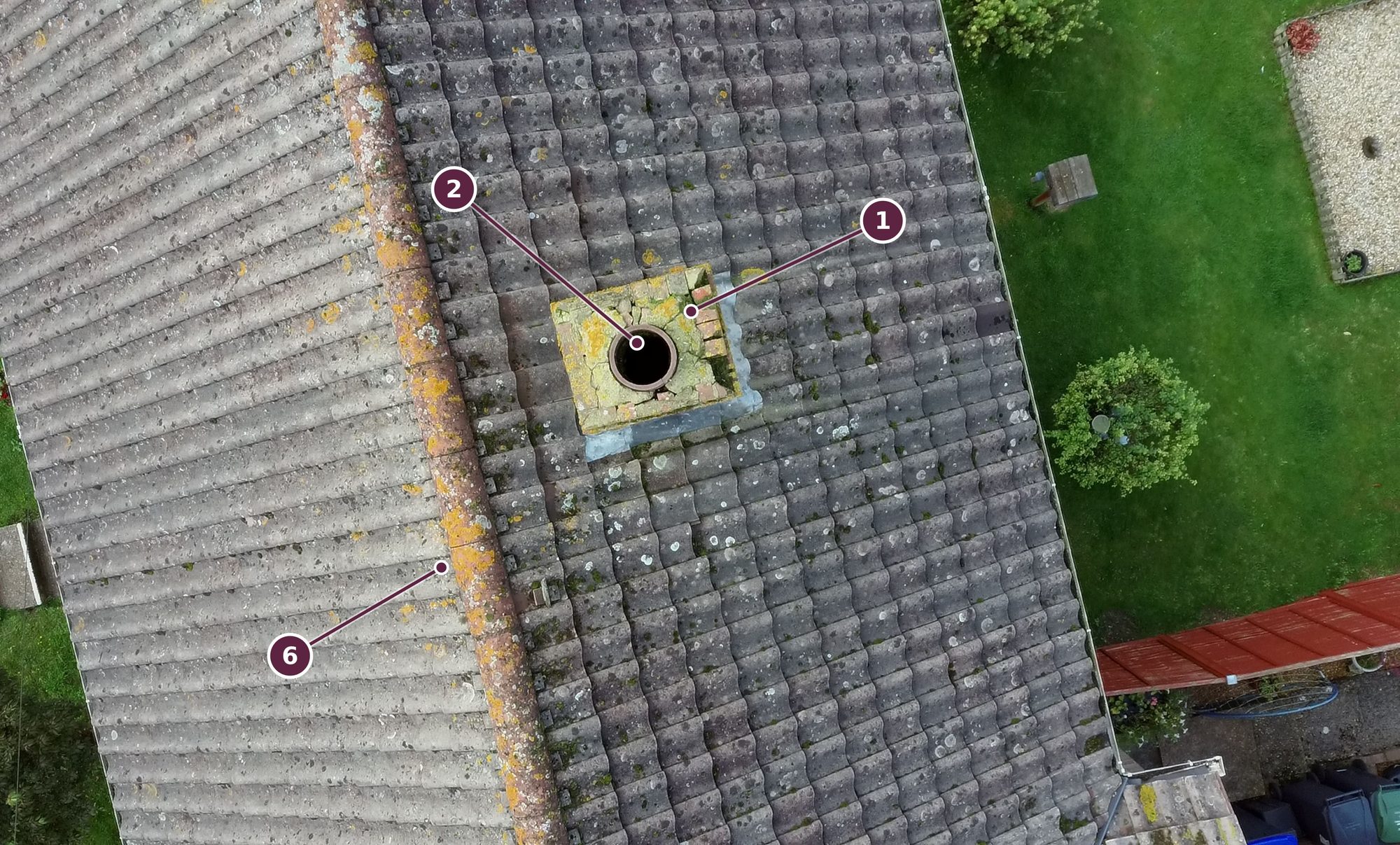
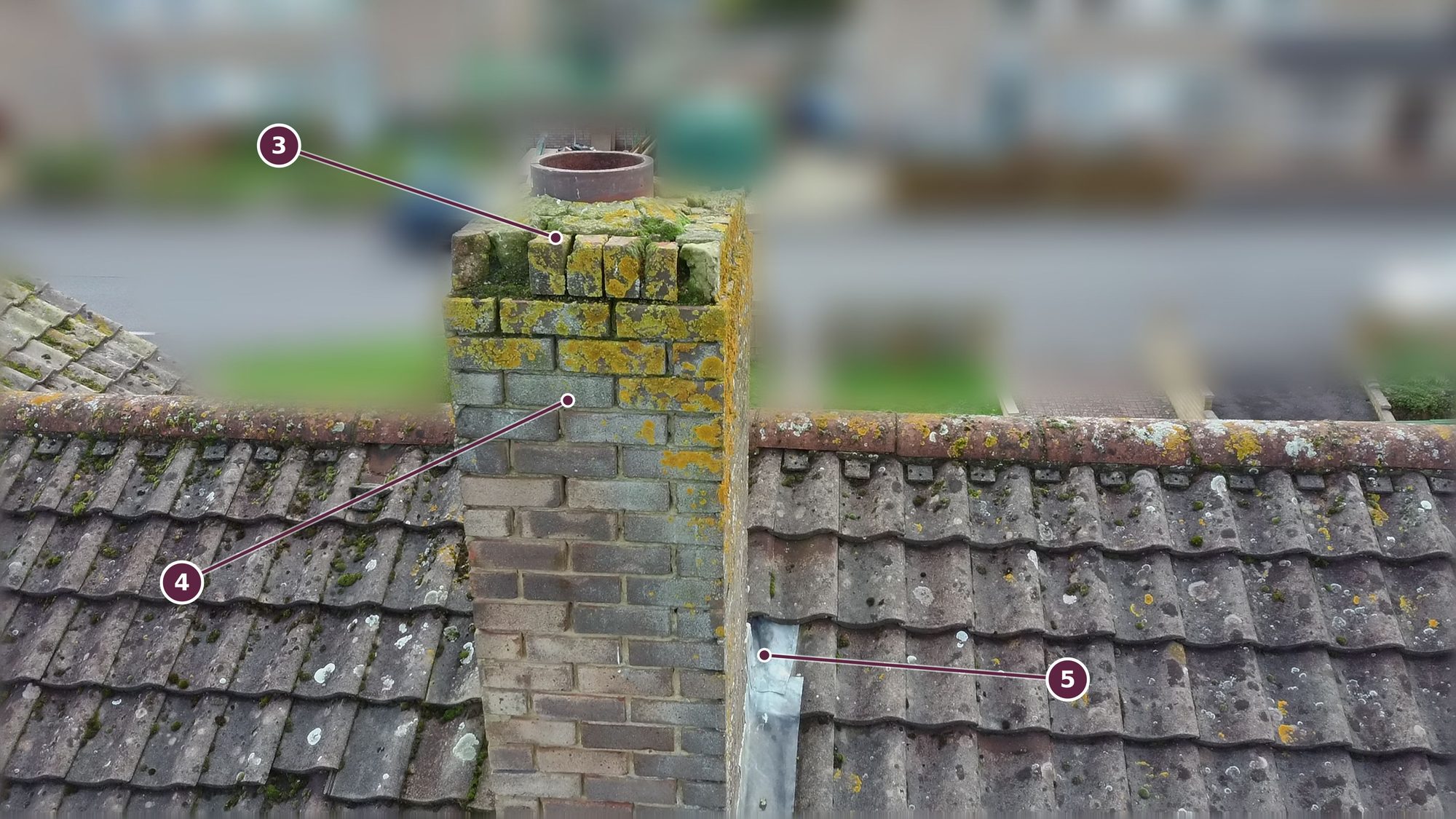
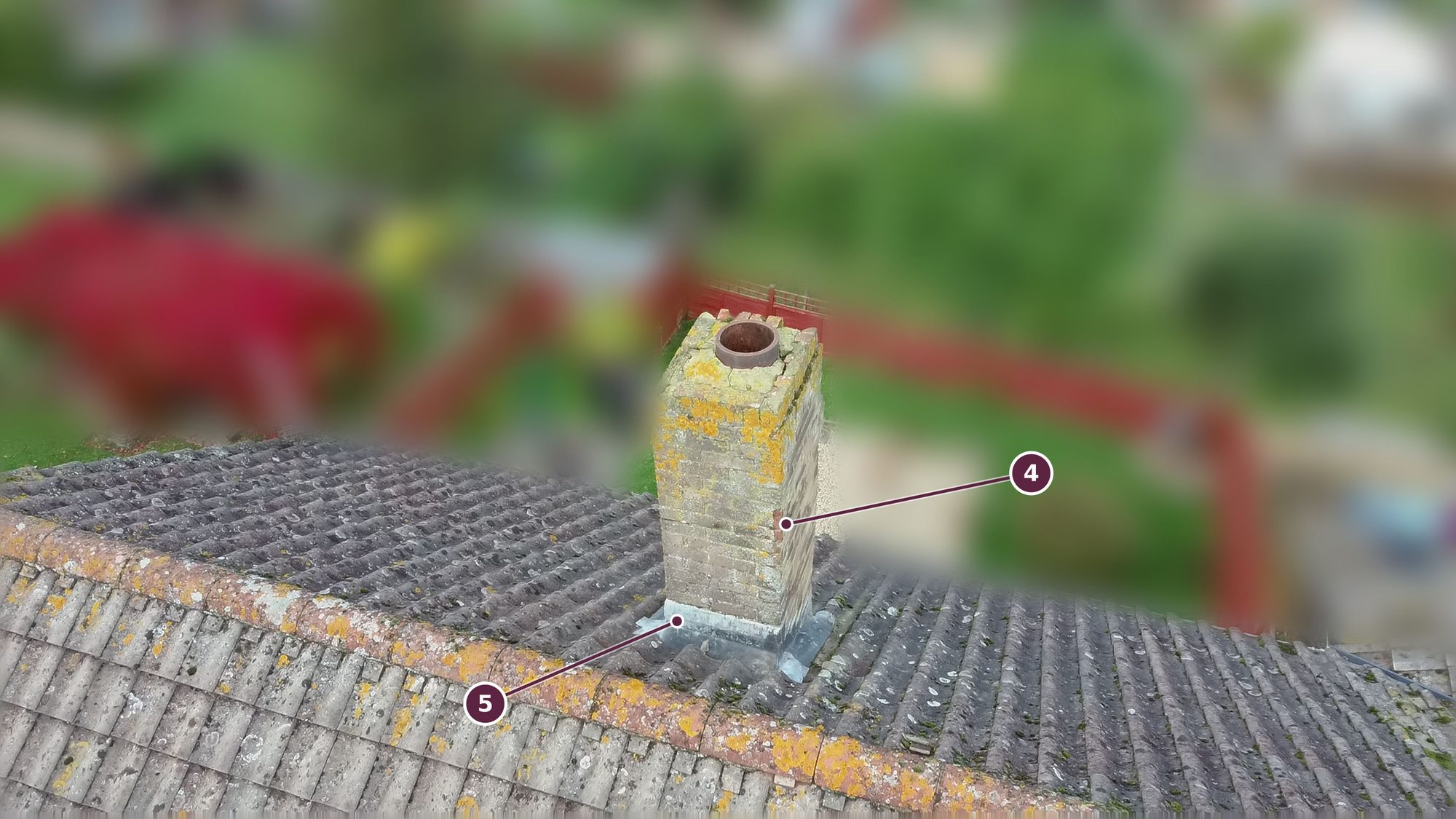
In this published sample, everything beyond the property’s own roofline is blurred — the street, neighbouring houses and gardens, and the people who were in them. Location data is stripped from the image files. The client’s own copy is unblurred and full resolution.
Recommendations
- Have a roofer quote for re-flaunching the crown and repointing the top courses. This is the substantive repair, and doing the two together means one access cost. Ask them to confirm the condition of the top courses once up there — if the brick faces have gone too far, rebuilding the top few courses is the right fix.
- Decide what the flue is for, then cap it accordingly. If the fireplace is unused, a vented cap keeps rain and birds out while letting the flue breathe. If it is in use, fit a cowl and bird guard suited to the appliance. Either is a small job to add to the same visit.
- Remove the vegetation on the crown as part of the repair — roots in mortar joints accelerate exactly the deterioration seen here.
- No action needed on the lead flashing or tiles now. Ask the roofer to re-dress the flashing corners while up there if convenient, and keep gutters cleared given the moss shedding off the roof. Worth re-checking after a hard winter.
Survey and report by Ashburn Stone — The Old Fire Station, Salt Lane, Salisbury. Questions about this sample or booking a survey: 01722 568 062 · hello@ashburnstone.co.uk
A standard visual survey like this one — a house, chimney or single roof — is from £180: one visit, the imagery and the written summary. Barns, warehouses and whole sites are bigger jobs and are priced by size.
Book a drone survey → Download this sample as a PDF